For everyday shoppers
How to read a clothing label in 60 seconds
A fast guide to composition labels: find the real fibre names, note the elastane percentage, treat bamboo as viscose unless lyocell is proven, and ignore plant-based or eco copy. Those words are not a health tier.
Start with the fibre list
Flip to the composition label, not only the wash icons. Read the fibre names in order of percentage. Note any stretch fibre by name and amount. Then look at the hangtag for stain, water, or “stays fresh” finish language. If you want a scored breakdown of that same label, scan the product.
If the hangtag says plant-based or eco, look for the fibre names and percentages. Those words are not a tier.
Have a garment and its label nearby? Check a product.
The two labels people mix up
In the United States, most clothing has to disclose fibre content, country of origin, and who is responsible for the product. That is a different rule from care instructions (FTC, Textile and Wool Acts), (FTC Care Labeling Rule). Other markets have their own statutes. The shopping move is the same.
- Composition. Generic fibre names and percentages by weight, usually highest first. This is the health-relevant starting point.
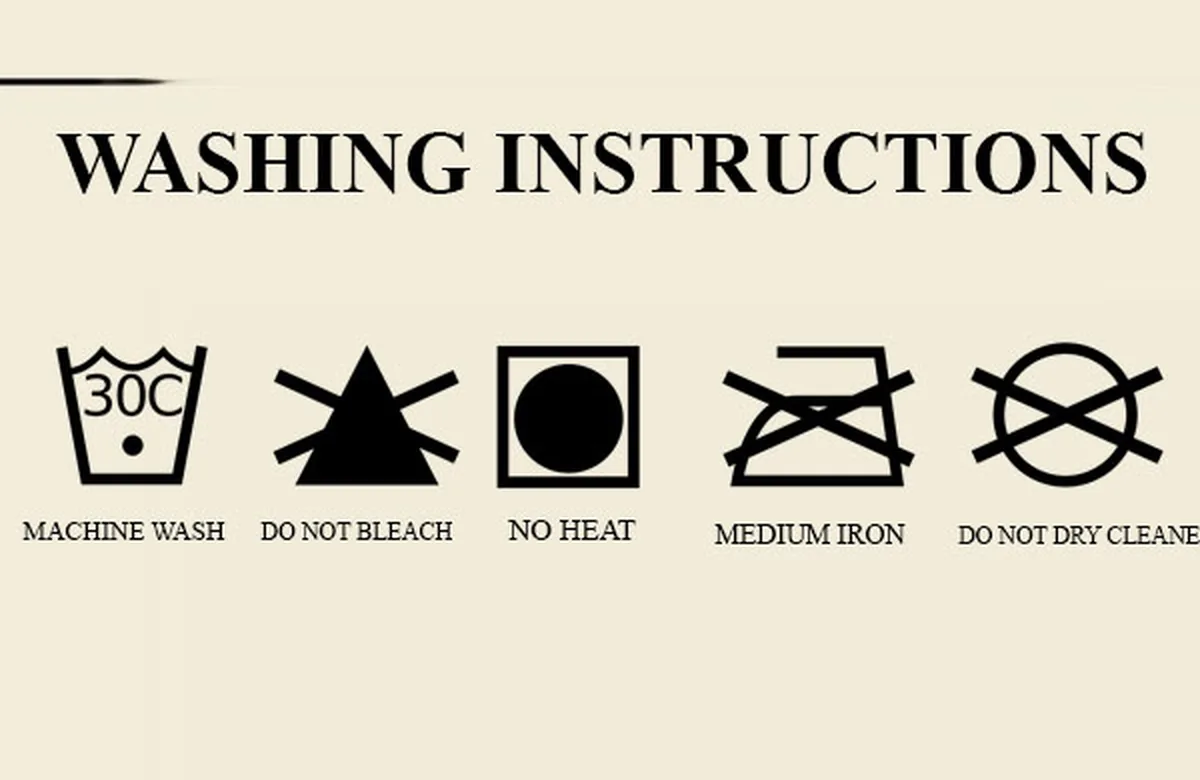
- Care symbols. Wash temperature, tumble, iron. Useful for keeping the garment intact. Weak for chemistry.
The two can share a tag. Read composition first when you are asking “what is this made of?”
Find the real fibre names
US rules want generic names, not only house trademarks. “60% cotton, 35% polyester, 5% elastane” means cotton dominates hand-feel and breathability, polyester adds durability and dry time, elastane adds stretch. Fibres under 5% can sometimes hide as “other fibre” unless they have a stated function, which is why a tiny stretch line is still worth noticing (16 CFR Part 303).
Watch for three renaming tricks:
- House names. Tencel is usually lyocell. Modal is a regenerated cellulose. Lycra is elastane. Map the trademark back to the generic class.
- Recycled prefixes. Recycled polyester is still polyester. Recycled nylon is still nylon. Feedstock is not a new fibre.
- Plant-based, eco, natural feel. Marketing. Not a fibre name, and not a TFD tier.
Our public fibre language, when we have one for that fibre, is only: Prefer, Better choice, Okay, Be careful, or Prefer less. We do not turn a vibe word into one of those five.
Call out the elastane percentage
A few percent elastane, spandex, or Lycra is common in jeans, underwear, and knits. It is a plastic. Write the number down in your head: 2% and 20% are different garments. For most people the tradeoff is fit. If you are trying to cut synthetics, look at the stretch line as carefully as the bulk fibre, then decide whether woven non-stretch is actually wearable for you.
Elastane is often the last number on the label. Skipping it because it looks small is how a “cotton” tee quietly becomes a cotton-plastic blend.
“Bamboo” is usually viscose
Soft apparel sold as bamboo is typically bamboo viscose or rayon: pulp dissolved and regenerated into a cellulosic fibre. US fibre rules treat that as rayon (or viscose), not as a magical plant cloth (FTC generic-name guidance). Soft, yes. Automatically “natural and toxin-free,” no.
TFD’s public read for that viscose process is Be careful, unless the label actually says lyocell (including Tencel) and that is the fibre you are buying. Lyocell is still regenerated cellulose, but it is a different process story from commodity viscose. Mechanical bamboo linen exists. It is rare in mass apparel. If the brand cannot show that, do not grade the garment as linen.
Same decode energy for viscose, rayon, and modal: plant origin, chemical process, read the generic name. For a longer parent-focused version of this split, see the kids’ underwear article.
Plant-based and eco are not a tier
“Plant-based,” “eco,” “conscious,” and “non-toxic” are not fibre names. They are not Prefer, Better choice, Okay, Be careful, or Prefer less. A polyester dress with an eco hangtag is still polyester. We read polyester as Prefer less, including recycled polyester, because wearer chemistry follows the polymer, not the bottle story.
GOTS and OEKO-TEX are real standards with real scopes. GOTS is a processing standard for certified organic natural fibres (GOTS). OEKO-TEX Standard 100 tests articles against a list of harmful substances and publishes limit classes (OEKO-TEX Standard 100). Ask what was certified: this garment, a fabric mill, a facility. Then still read the fibre list. A badge does not replace a percentage, and it does not mint a TFD tier on its own.
Finish claims that deserve a pause
Stain proof, waterproof, water repellent, PFC, PFAS, DWR, or heavy antimicrobial “won’t smell for weeks” points to chemistry on top of fibre. That is where many PFAS concerns concentrate, not in a plain cotton tee (ATSDR, preventing exposure). Green claims on the same hangtag do not reliably predict PFAS free (Rodgers et al., 2022).
A 20-second table
| You see | You ask | Do not confuse with |
|---|---|---|
| 100% cotton | Breathable baseline. Any stain or water claim? | A finish-free guarantee. Dyes and treatments can still be present |
| High % polyester | Plastic fibre. Recycled prefix or not? | A health upgrade because the bottle was recycled. Still Prefer less |
| Bamboo, viscose, rayon | Regenerated cellulose. Viscose process unless lyocell is proven | A natural-linen shortcut. Public read: Be careful unless lyocell |
| Elastane, spandex, Lycra 1–5%+ | What is the actual percentage, and is it next to skin? | A free pass to ignore the stretch line |
| Plant-based, eco, conscious | Where is the generic fibre list? | A TFD tier. It is not one |
| Stain / waterproof / DWR | Finish first, then fibre | Proof that the base fibre is the whole story |
| OEKO-TEX / GOTS | What exactly is certified, product or process? | A raised health number. They check limits and process |
When a scan helps
A label you cannot parse in a store aisle is exactly when to paste the product into Toxic Fashion Detector. The method behind the Fashion Health Score is public, at a high level, on the scoring method. We publish what we look at. We do not publish the internal weights.
Practice on three things you already own: a tee, athletic bottoms, and outerwear. Compare polyester share, elastane percentage, and finish claims. For cleaner brand defaults, see the brand directory.
Sources
- Federal Trade Commission. Threading Your Way Through the Labeling Requirements Under the Textile and Wool Acts. Fibre content, generic names, and country of origin.
- Federal Trade Commission. Care Labeling of Textile Wearing Apparel and Certain Piece Goods. Separate from fibre-content disclosure.
- 16 CFR Part 303. Rules and Regulations Under the Textile Fiber Products Identification Act, including generic names and fibres under 5 percent.
- ATSDR / CDC. How to Prevent PFAS Exposure.
- Rodgers K. M. et al. (2022). How Well Do Product Labels Indicate the Presence of PFAS in Consumer Items Used by Children and Adolescents? Environmental Science & Technology Letters.
- Global Organic Textile Standard. The Standard. Processing standard for certified organic natural fibres.
- OEKO-TEX. STANDARD 100: textiles tested for harmful substances, with limit values by skin-contact class.